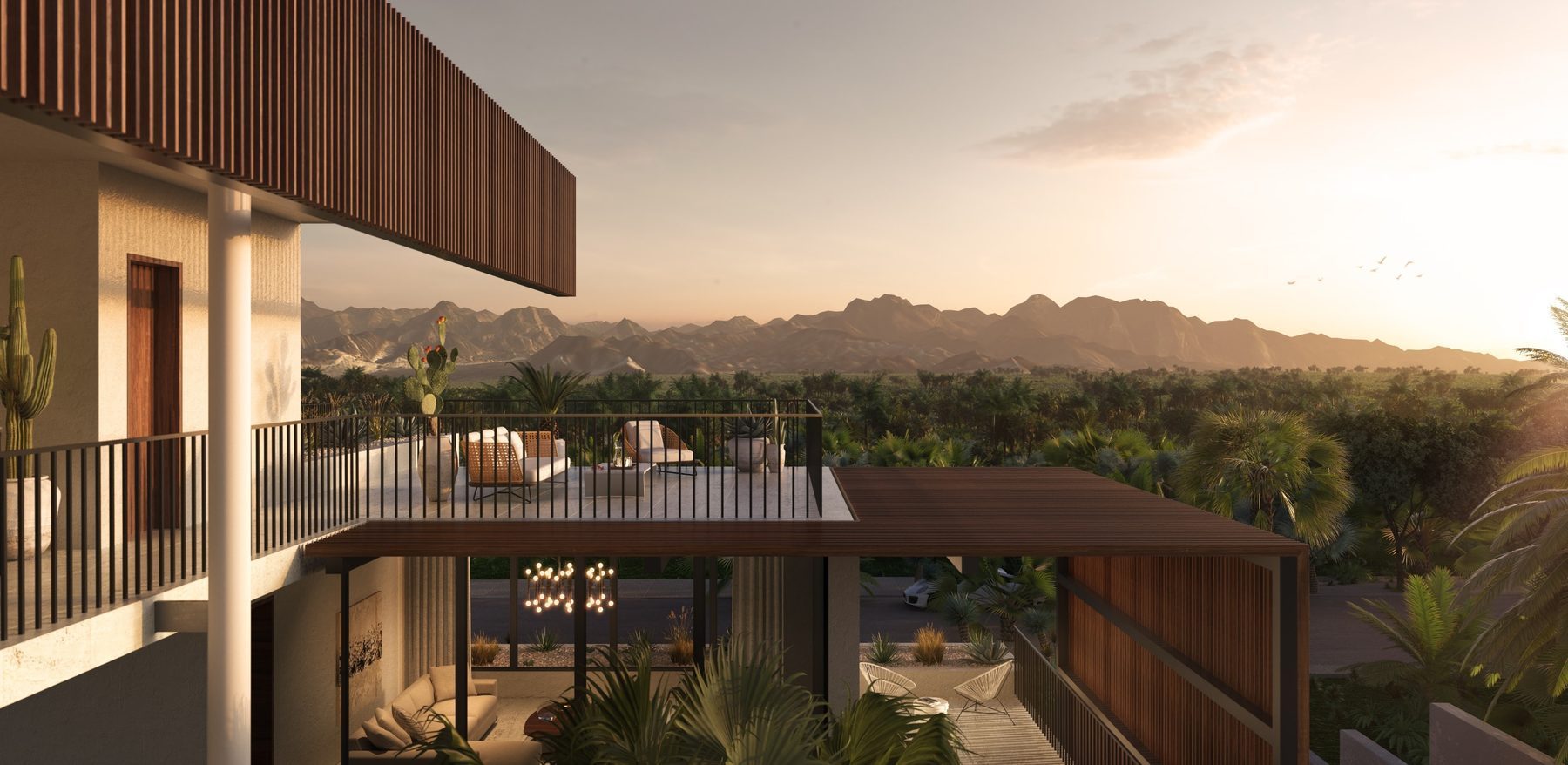
I have coached and worked with high-net-worth individuals for decades, and the private equity and venture capital crowd has a buying pattern unlike any other demographic in Cabo. The income is lumpy. The tax situation is complex. The decision-making is analytical to a fault. But when a carry distribution lands or a fund exits, the window opens — and an increasing number of PE and VC professionals are parking that capital in Los Cabos real estate.
Key Takeaways
- ✓ PE/VC professionals typically target $2.5M–$4M properties, with carry distributions funding the purchase
- ✓ Querencia, El Dorado, and Chileno Bay are the top communities for this buyer profile
- ✓ Cabo property depreciation (30-year straight-line) can offset passive K-1 income on US returns
- ✓ Most PE buyers spend 4–8 weeks/year in Cabo — well below the 183-day Mexico tax residency trigger
- ✓ SJD is 2.5 hours nonstop from SFO, 3 hours from JFK — accessible for weekend and deal-break travel
PE or VC Professional Looking at Cabo?
I work with fund managers and partners to match their income timing, tax strategy, and lifestyle to the right property.
Contact UsWhy the PE and VC Crowd Is Buying Cabo
I started noticing the trend around 2023: a disproportionate number of buyers at Querencia and El Dorado were coming from the fund world. Not hedge fund traders — they go to the Hamptons or Miami. I mean the illiquid-asset crowd: private equity partners, venture capital GPs, growth equity managers, and the family offices that invest alongside them.
The reasons cluster into three buckets:
Proximity and the Flight Map
Los Cabos sits at the sweet spot of the nonstop flight map for US financial centers. San Francisco to SJD is 2.5 hours. Los Angeles is 2 hours. New York JFK is about 5.5 hours but multiple nonstops run daily. Dallas and Houston are 3 hours. Southwest, Alaska, American, Delta, United, and JetBlue all fly the routes, with frequencies increasing every year.
For a partner who works 60-hour weeks but has flexibility between deal closings and fund raises, that flight map means Cabo is usable on a long weekend. Friday afternoon flight, three nights, Sunday night return. You cannot do that with Europe or the Caribbean on any rational schedule.
The Work Pattern Fit
PE and VC professionals do not work 9-to-5. They work in cycles: intense deal execution periods, followed by quieter monitoring and fundraising periods. A lock-and-leave property in Cabo fits this rhythm perfectly. Use the property intensively during slower periods — typically January through March (post-holidays, before spring deal season) and June through August (summer lull). Lock it up, have your property manager maintain it, and potentially generate rental income during peak season when you are heads-down on deals.
Asset Diversification
Fund professionals understand concentration risk better than any other buyer segment I work with. Their net worth is typically heavily concentrated in: (a) fund carry, which is illiquid and correlated to private markets, (b) co-investments alongside the fund, and (c) public equities. A hard asset in Mexico, denominated partly in pesos and generating income in dollars, provides genuine portfolio diversification. It is uncorrelated to US markets, tangible, and usable.
Timing Purchases Around Carry Distributions
This is the section that matters most to PE buyers, because it is the one nobody else writes about.
Carried interest distributions are inherently unpredictable. A fund exits a portfolio company, distributes proceeds, and the GP's carry share lands — sometimes $500K, sometimes $5 million or more. The timing depends on deal flow, market conditions, and LP liquidity preferences. You cannot plan around it the way you plan around a W-2 salary.
Here is how the smart PE buyers I work with handle this:
- Pre-qualify before the carry hits. Work with a Cabo agent (me, or someone who understands this) to identify 3–5 target properties in your preferred community and price range. Do the walkthrough, understand the market, know what you will bid when the capital arrives
- Set aside the purchase capital in a separate account. When carry distributes, move the after-tax amount earmarked for Cabo into a dedicated account. Do not commingle it with reinvestment capital or personal spending. The purchase decision should be made independent of the distribution event
- Execute quickly. The Mexico closing process takes 60–90 days from signed purchase agreement to keys. If you have done your homework, you can go from carry distribution to Cabo homeowner in under 90 days
- Consider tax timing. Carry distributions are typically taxed as long-term capital gains (20% federal + 3.8% NIIT for most PE professionals). If the distribution occurs in December, you may want to close the Cabo purchase in the same tax year to begin depreciating the property and generating offsetting deductions. Your CPA should model this
The Tax Strategy for PE Cabo Owners
I am not a CPA, and this is not tax advice — but I can tell you what the PE buyers I work with are doing with their advisors.
Depreciation Against K-1 Income
US taxpayers who rent their Cabo property can depreciate the structure over 30 years (straight-line method for foreign property). On a $3 million property with a 70/30 structure-to-land split, that is $70,000 per year in depreciation. For a PE partner receiving passive K-1 income from fund investments, this depreciation offsets that income dollar for dollar — if the Cabo rental activity is also classified as passive. At a 37% marginal rate, $70,000 in depreciation saves $25,900 in taxes annually.
Foreign Tax Credits
Mexico taxes rental income at progressive rates. The US-Mexico tax treaty allows you to claim a Foreign Tax Credit on your US return for Mexican taxes paid, preventing double taxation. Your Mexican tax liability on rental income typically runs 15–30% of net income, and every peso paid to SAT reduces your US tax bill.
The 183-Day Trap
Spending more than 183 days in Mexico in a calendar year can trigger Mexican tax residency — meaning Mexico taxes your worldwide income, including K-1 distributions from US funds. For PE professionals with significant K-1 income, this is catastrophic. Most PE buyers spend 4–8 weeks in Cabo per year, well below any threshold. Track your days carefully. Use a travel log app. Do not get casual about this.
FBAR and FATCA
If you open a Mexican bank account (useful for paying HOA fees and property taxes in pesos), you trigger FBAR and FATCA reporting requirements. This is routine for PE professionals who are accustomed to complex tax filings, but do not forget about it. The penalties for non-compliance are severe.
Need Help Structuring Your Cabo Purchase?
I work with cross-border CPAs and Mexico attorneys who understand fund economics. Let me connect the dots.
Book a Strategy CallWhich Communities Match the PE Lifestyle
Not every Cabo community fits the PE buyer profile. Here is where the fund money goes and why:
Querencia — The Default Choice
Querencia attracts the highest concentration of finance and tech money in Los Cabos. The private club model resonates with PE professionals — it feels like a club deal, not a resort. Two Tom Fazio golf courses, the $60 million renovation, wine cave, organic farm, world-class spa. Average home price north of $5 million. The member community includes other fund managers, Fortune 500 executives, and professional athletes. For PE partners who value a peer group, Querencia is the answer. Initiation fees run approximately $250,000.
El Dorado — Ultra-Private
El Dorado Golf & Beach Club is Discovery Land Company's Cabo property — and it is the choice for PE professionals who want zero public exposure. No hotel. No branded component. No tourism. Just 600 acres, a Jack Nicklaus course, a surfing beach, and some of the wealthiest people in North America behind a very quiet gate. Homes run $5M–$25M+. This is where the fund founders and managing partners go.
Chileno Bay — For Entertaining
PE partners who host clients, LPs, or portfolio company management teams gravitate to Chileno Bay. The Auberge resort provides a turnkey hospitality platform — you can host a dinner for 12 at the resort, take clients fishing in the morning, and have them back at the airport by evening. The swimmable beach and walkable community feel make it less isolated than Querencia or El Dorado. Residences range from $2M–$10M+.
Diamante — The Sports Play
Diamante draws the PE buyer who defines leisure through athletics. Tiger Woods' Legacy course, the Dunes course by Davis Love III, the 10-acre Crystal Lagoon, and the Pacific surf break create an amenity stack that no other community matches. For the PE partner who golfs obsessively and wants to bring deal partners, Diamante is the social currency play.
Ownership Structures for PE Buyers
The standard structure is a fideicomiso (bank trust) with the PE buyer as the beneficiary. This is straightforward and works for most situations.
Some PE buyers explore additional layers:
- US LLC as fideicomiso beneficiary: Provides an additional liability shield and simplifies estate planning. The LLC structure must be carefully designed to avoid adverse tax treatment — the IRS may classify a single-member LLC as a disregarded entity, which passes through cleanly, but multi-member LLCs create partnership tax reporting
- Mexican corporation (SA de CV): Appropriate for properties generating significant rental income, as corporate tax rates may be more favorable than individual rates for high earners. But the compliance burden is higher
- Trust-to-trust structures: For PE professionals whose US estate plan already includes trusts, coordinating the US trust with the Mexican fideicomiso requires specialized legal counsel on both sides of the border
The key principle: your Cabo ownership structure should be designed by a team that understands both US partnership tax law and Mexican property law. Do not let your Mexico attorney design the US side, and do not let your US attorney design the Mexico side. You need both in the room.
What the PE Lifestyle Looks Like in Cabo
The typical PE professional I work with uses their Cabo property 5–8 weeks per year, distributed roughly like this:
- January (2 weeks): Post-holiday decompression. LP annual meeting prep on the terrace. Golf in the afternoon. This is the #1 usage period
- March/April (1 week): Spring break with family. The kids are out of school, the weather is perfect, the property earns its keep as a family asset
- June (1–2 weeks): Summer kickoff. Often a partner retreat or LP entertainment event combined with family time
- October (1 week): Pre-peak-season visit. Check on the property, meet with the property manager, prepare for winter rental season
The remaining 44–47 weeks, the property is either in a rental program (generating $80K–$200K+ in annual revenue depending on the property) or locked down under property management ($1,500–$3,000/month for maintenance, security, and upkeep).
The Bottom Line
Cabo real estate is not a private equity deal. There is no IRR model that captures the value of watching your kids build sandcastles on Chileno Bay after a brutal Q4. But PE and VC professionals bring a rigor to real estate decisions that serves them well here — they underwrite the carrying costs, model the rental income, structure the ownership thoughtfully, and time the purchase around liquidity events.
If you are in the fund world and have carry on the horizon, do the homework now. Identify the communities, understand the numbers, and be ready to execute when the distribution hits. The Cabo market rewards prepared buyers.
Fund Professional? Let's Talk Strategy.
I help PE and VC buyers match carry timing, tax strategy, and lifestyle preferences to the right Cabo property.
Contact Us TodayFrequently Asked Questions
Why are PE and VC professionals buying property in Cabo?+
Three reasons dominate. First, proximity: Los Cabos is a 2.5-hour nonstop flight from San Francisco, 3 hours from New York, and 2 hours from Houston — making it accessible for weekend use. Second, the lifestyle matches the work pattern: PE/VC professionals often have intense 60–80 hour work weeks punctuated by periods of flexibility between deals or fund raises, making a lock-and-leave property ideal. Third, asset diversification: fund managers understand concentration risk and appreciate parking capital in a hard asset denominated partly in a foreign currency as a hedge against domestic market correlation.
How does carried interest income affect Cabo property purchases?+
Carried interest creates a unique buying dynamic. When a fund exits a portfolio company and distributes carry, a GP partner might receive $500K to $5M+ in a single event — but it is unpredictable timing. Smart PE buyers pre-qualify and identify target properties in advance, then execute quickly when carry hits. The typical timeline from carry distribution to Cabo closing is 60–90 days. Because carry distributions are often taxed as long-term capital gains (currently 20% federal plus 3.8% NIIT), some buyers time their Cabo purchase to create offsetting deductions — particularly through rental property depreciation.
Can I depreciate a Cabo property on my US taxes?+
Yes. US taxpayers who rent their Cabo property can depreciate the structure (not the land) over 30 years using the straight-line method. For a $2 million property with a 70/30 structure-to-land split, that generates roughly $46,667 in annual depreciation. For PE professionals in the highest tax brackets, this deduction offsets other passive income from K-1 distributions. However, you must file IRS Form 4562, report rental income on Schedule E, and claim the Foreign Tax Credit for any Mexican taxes paid. A cross-border CPA is essential.
Which Cabo communities attract PE and VC buyers?+
Querencia is the top choice — it attracts the highest concentration of finance and tech money in Los Cabos. The private club model, two Tom Fazio golf courses, and $5M+ average home price create a peer group that PE professionals recognize. El Dorado (Discovery Land Company) is for the ultra-private set who want zero public exposure. Chileno Bay attracts PE partners who entertain clients — the Auberge resort access and walkable beach are ideal for hosting. Diamante draws the sports-oriented PE buyer with Tiger Woods' course and the Crystal Lagoon. Palmilla is the classic choice for buyers who want One&Only resort access.
What are the tax implications of K-1 income for Cabo property owners?+
K-1 income from fund investments is reported on your US tax return regardless of where you live. If you spend more than 183 days in Mexico, you could trigger Mexican tax residency and be subject to Mexican tax on worldwide income — including K-1 distributions. Most PE professionals structure their time carefully: they spend 4–8 weeks per year in Cabo, well below any residency threshold. The property generates its own K-1 if structured through a US entity, creating a paper trail that your accountant can work with. The key is coordination between your fund administrator, your personal CPA, and a Mexico tax advisor.
How do PE buyers typically structure Cabo property ownership?+
Most use a standard fideicomiso (bank trust) for the Mexico side. Some PE professionals explore holding through a US LLC that is the beneficiary of the fideicomiso, which can provide additional liability protection and simplify estate planning — though the IRS and Mexican tax treatment of LLCs requires careful structuring. Mexican corporations (SA de CV) are used less frequently by PE buyers but may make sense for properties generating significant rental income. Your structure should be designed by a team that understands both US partnership tax law and Mexican property law.
What is the typical property budget for PE/VC Cabo buyers?+
The range is wide but clusters in two tiers. Associates and VP-level buyers (pre-carry, relying on salary and bonus) typically target $800K–$1.5M — nice condos in Cabo del Sol, Palmilla Dunes, or Copala at Quivira. Partners and managing directors (post-carry) target $2M–$8M — villas and estate homes in Querencia, Chileno Bay, or El Dorado. A subset of senior partners and fund founders go $10M+ for trophy properties in El Dorado or custom builds. The median PE buyer I work with spends $2.5M–$4M.
Aaron Cuha
Real Estate Advisor & Los Cabos Market Expert
Real estate advisor and founder of Living In Cabo. 15+ years helping families navigate complex real estate decisions. Strategic partner with Ronival — Baja's largest brokerage.